

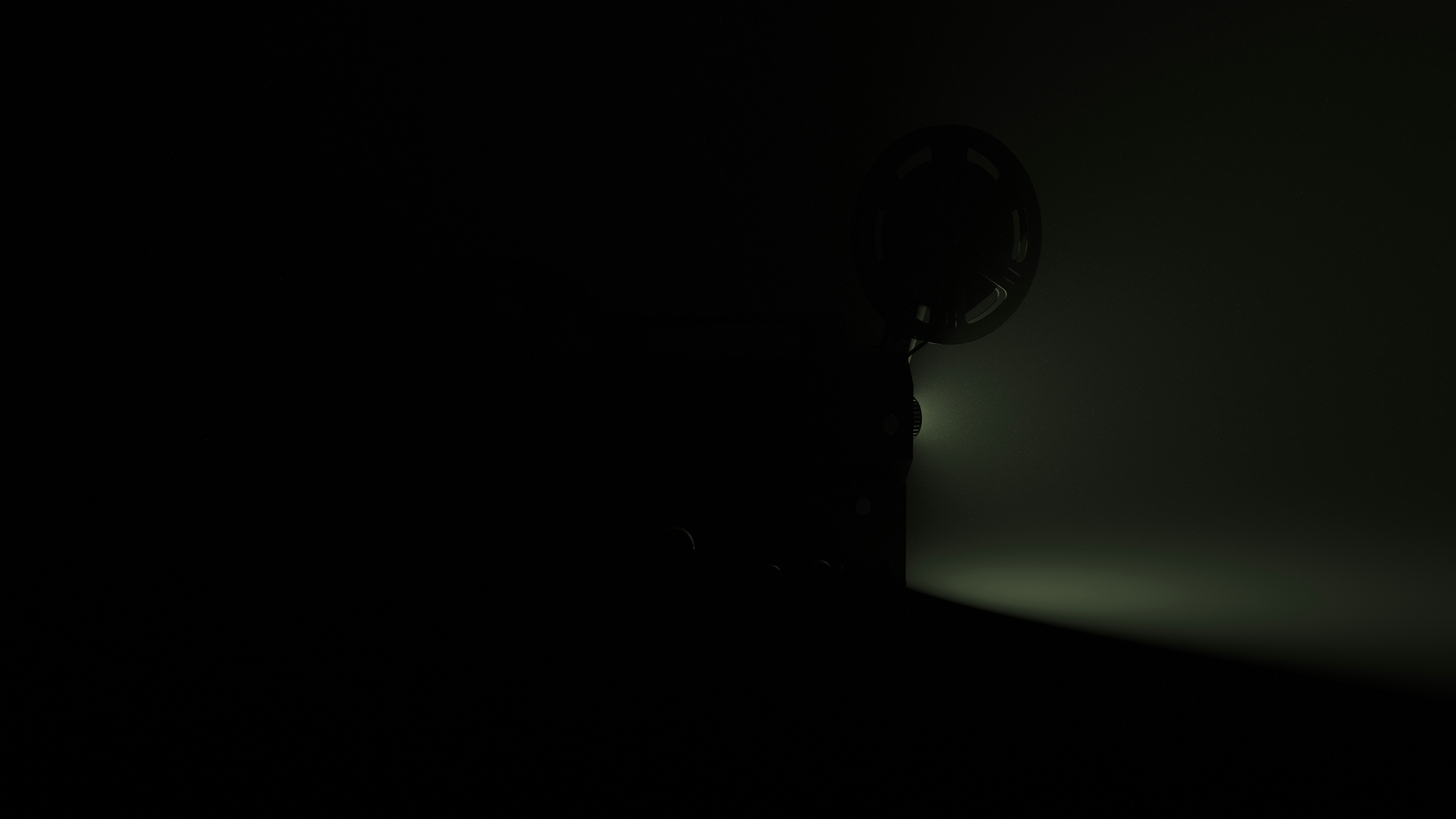
He hit the switch. The cellar resolved. Cement. Cobwebs. The pews. The shapes on the pews, which he had stopped calling children some time ago and now called nothing. The masks did the breathing. None of them had tried the stairs in years.
He coughed. The dust got him every time.
On the landing behind him, a magazine. His face on the cover. He had stepped over it coming down. Someone kept bringing them. He had stopped wondering who.
He threaded the first reel.
Penelope mid-spin, mid-sentence. The cows behind her in a row. The meter jumped green and he watched the green and felt the small dry pleasure of confirmation.
The reel ran. Eleven minutes. He knew the length of every reel in the cellar without checking. He had threaded Penelope perhaps four thousand times. The number was approximate. He had stopped counting around the time he had stopped counting other things.
The notebook was upstairs in a drawer. 1 Xmo laughter, 3 Xmos tears. He had written it in a hand that believed in itself. The souffle had been a real thing once. Apricot. Served too hot. They had burned their mouths and thanked him for it. He could recall the warmth. The face would not come.
The reel ended. He threaded another.
The boy on the rock. The dog. We’re gonna be just fine, Bo. The fiddle coming in low. The crocodile tear carving its path. He had wept at this once. He could not now remember why. The meter went red. Red. Red. The shapes on the pews curled slightly inward and he watched the curl through the back of the nearest skull, the ears pulling toward the bone, and the meter jumped, and he watched the meter, and the meter was the only thing in the room that was alive, and he was watching it the way a man watches the breathing of a child he loves, except that there was no child and no love and only the watching.
The reel ended.
He threaded another.
Outside the cellar a phone was ringing. It had been ringing for some time. He didn’t know whose. He didn’t know his own anymore. The galas went on without him. The checks accumulated in a room he had stopped entering. There was a man who answered the phones now, whose name he had known once, who wrote reports which he did not read.
The new reel. A woman in a kitchen. She was laughing at something off-screen, a man’s voice probably, the laugh going on too long the way laughs do when they’re being performed for a camera. The meter jumped green. He watched the green.
Between reels there was a sound.
He had decided long ago not to think about the sound. It was a sound that pressed. He threaded faster between reels now than he had a year ago. He had not made a decision to thread faster. His hands had made the decision and he had ratified it by not noticing.
On the second pew, a foot. Bare. The big toenail had grown long and curved down over the tip of the toe and back under it, the way a nail grows on a body no one is tending. He had seen it before. He saw it now. She was somewhere in the pews. He did not know which one. He had stopped being able to tell them apart around year two.
He threaded.
A man eating a sandwich. Three seconds. Splice. A horse falling down. The horse got up. The horse fell down again. The footage looped, he knew, because he had spliced it himself, years ago, when he had first understood that the meter did not care about narrative. The horse fell. The meter jumped green for some of them and red for others. The horse fell. The horse fell. The films had started arriving on their own at some point. He had not ordered them. They came in flat metal cans left at the top of the stairs. He carried them down and added them to the shelves and threaded them. Someone upstairs was running a system he had once run and the system continued without him and supplied him with reels the way a hospital supplies a patient with food, on a schedule he no longer set.
He understood, dimly, that there were other cellars. Other men threading. The cans came from somewhere. The somewhere had its own cellars and its own men and its own pews. He had been on a pew once. He remembered the meter. He did not remember agreeing to it. He did not remember not agreeing. The reel caught.
Penelope again. The cows. The meter jumped green.
He watched the meter. He watched the meter. He watched the meter.
A shape on the third pew shifted. A hand that had been resting on a knee moved to the bench and rested there.
The reel ended. He threaded another.
Outside, the phone had stopped ringing. He noticed the absence the way he noticed most absences, which was as a small wrongness that he did not pursue. Somewhere a decision had been made about him by someone he could not name. The magazines would keep coming. The reels would keep coming.
He threaded.
The boy on the rock again. His hands had reached for it without consultation. We’re gonna be just fine, Bo. The fiddle. The tear. The meter. Red. Red. Red. The shapes curled.
He thought of climbing the stairs. The thought arrived sideways, in a gap. He examined it. He found it had no force.
He could walk up the stairs. He could do this.
He pictured the first step. Not the second.
He threaded another reel.
The sound pressed. He turned the projector volume up. It was already at maximum. He had turned it to maximum some weeks ago and had not turned it back down. The sound came through the projector now, under Penelope’s voice, under the fiddle, under the horse falling. He had stopped being able to not hear it. He told himself it was the building settling. He had told himself this for a long time. He threaded faster.
A new can sat on the top step. He had not heard it arrive. He climbed to retrieve it, which was the only reason he climbed now, and the climbing did not count, because the landing was still the cellar, and the can in his hands was already warm from someone else’s hands, and the someone else had chosen not to come down, and he understood, carrying the can back to the projector, that the arrangement upstairs required his cooperation in the same way the arrangement downstairs required the cooperation of the shapes on the pews, and that he had cooperated, and that the cooperation was indistinguishable from his life.
He threaded.
A child’s birthday. Candles. The singing. The meter held green and the shapes leaned forward as one, the way wheat leans, and he had been standing in the current so long he had mistaken it for stillness.
The reel ran out.
He threaded.
A wedding. The meter held.
He threaded.
A funeral. The meter held.
He threaded. He threaded. He threaded.